


Key takeaways
- In a multi-client 3PL, several client peaks often land in the same weeks and compete for the same storage, pick stations, docks and carrier cutoffs.
- Capacity planned around each client's average volume breaks down when peaks overlap.
- The best preparation is mapping every client's peak calendar, planning for the overlap weeks and agreeing priority rules in advance.
- Goods-to-person automation helps because robots, workstations and storage can be shifted between clients as demand moves.
What is an overlapping peak in a 3PL?
An overlapping peak happens when two or more clients in the same 3PL facility reach their highest volumes in the same period. Each peak may be manageable alone, but together they compete for shared resources inside one building.
A retail client may surge ahead of Black Friday, a direct-to-consumer brand around Cyber Monday, a subscription client in the first week of December and a B2B client before year-end. In a single-company distribution center, peak is one curve. In a 3PL, it is several curves stacked on top of each other.
"Most 3PLs don't struggle with one big peak. They struggle with differing peaks throughout the year, each varying processes, and difficulty accurately forecasting for those peaks. That is when they find out their capacity plan was built on averages."
Kyle Curry, Head of Strategic Accounts, Geek+ Americas
Why are overlapping peaks harder than one large peak?
Overlapping peaks are harder because clients share the same resources but keep their own service levels, cutoffs and order profiles. When capacity runs short, the 3PL has to decide whose orders go first, often under time pressure.
- Shared resources: one client's surge takes floor space, stations and dock time from the others.
- Separate service levels: every client's cutoffs and expectations still apply during peak.
- Priority conflicts: capacity decisions get made in the moment instead of in advance.
- Mixed order profiles: case picking for one client and single-unit e-commerce orders for another draw on resources differently.
- Hidden overlap: plans built on average volumes look sound until several peaks coincide.
Where does the pressure show up first?
The pressure usually appears first in forward pick space, pick stations and outbound cutoffs, because those are the resources every client needs at the same time.
- Forward pick locations for several clients' fast-moving SKUs
- Pick stations that can only work one client's orders at a time
- Carrier cutoffs that leave no room for delay
- Dock and staging space during overlapping outbound waves
- Visibility into each client's volume and order status
How should a 3PL plan capacity for overlapping peaks?
A 3PL should plan capacity around the weeks when client peaks overlap, not around annual or average volumes, and agree with clients in advance how capacity is shared when it gets tight.

A shelf-to-person layout keeps storage, robot traffic and pick stations in zones that can be reassigned as client volumes change.
- Map every client's peak calendar. Know which weeks each client surges, not only annual volume.
- Size capacity for the overlap weeks. Plan for the periods when peaks coincide.
- Agree priority rules in advance. Decide how capacity is shared before it becomes urgent.
- Build in ways to move capacity. The more easily space, stations and equipment can shift between clients, the less one client's surge affects the rest.
How does automation help 3PLs during overlapping peaks?
Automation helps when it can move capacity between clients. Goods-to-person robots and workstations that are not tied to one client can be reassigned by the day or the hour, so capacity follows whichever client is peaking.
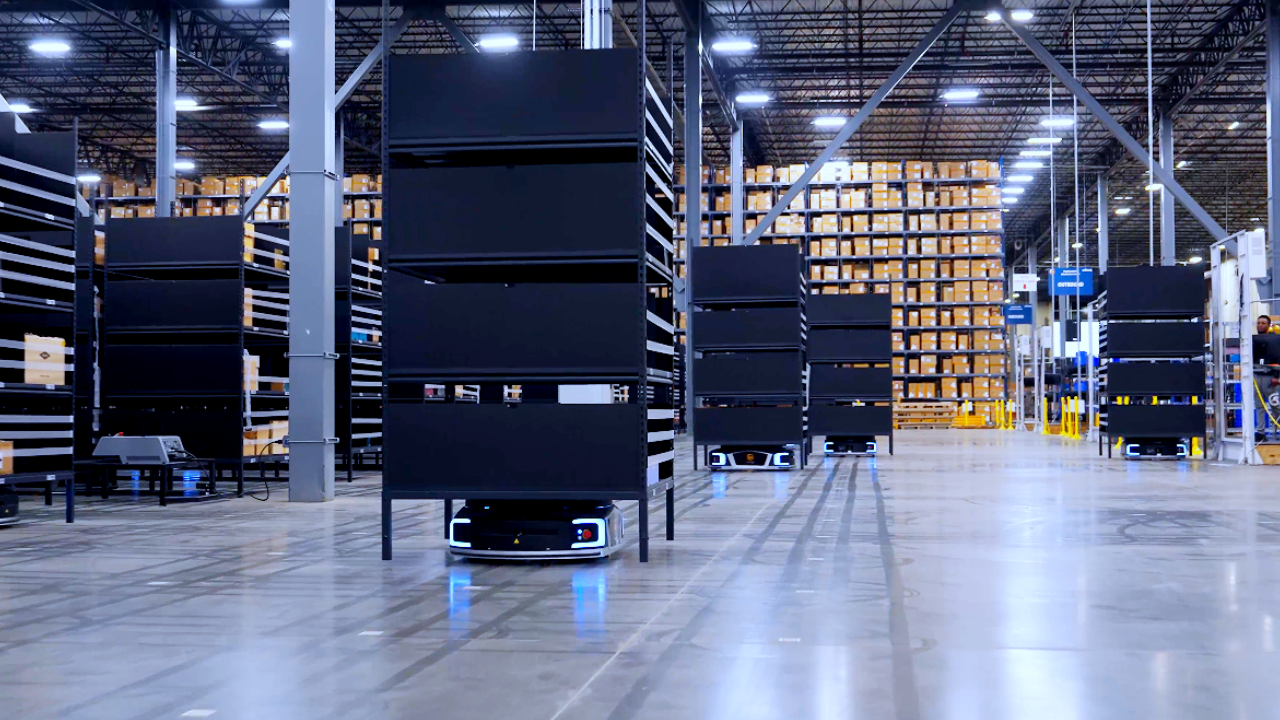
Goods-to-person robots bring shelves to pick stations, so the same fleet can serve whichever client is peaking.
Geek+ P800 robots and their workstations can be assigned to different client zones and rebalanced as volumes change. Dense Shelf-to-Person and RoboShuttle storage keeps several clients' inventory close to the pick stations. The orchestration software, integrated with the 3PL's WMS/WCS, applies each client's rules and priorities, sequences work against cutoffs and shows the status of every client in one view.
For example, UPS Supply Chain Solutions started with 27 P800 robots for Allbirds and scaled to 184 across two warehouses, with a 97% increase in peak unit throughput year over year.
Automation does not replace planning. It makes the plan easier to adjust when actual volumes differ from the forecast.
What should a 3PL review after peak?
After peak, a 3PL should review which weeks client peaks overlapped, where cutoffs were missed and for which clients, and which zones or stations ran out of capacity. This data is more reliable than forecasts made months earlier.
To see how one fulfillment provider prepared for Black Friday, Cyber Monday and tight next-day cutoffs, read the THG Fulfil peak season case study.
Want a second set of eyes on your peak data?
Request a free automation assessment for your 3PL operation. If automation is not the right fit, we will tell you.


