
Shanghai, July 17, 2026 — Geek+, a global leader in intelligent robotics, today unveiled Gravity, its unified embodied AI framework for long-horizon, complex physical tasks, at the 2026 World Artificial Intelligence Conference (WAIC). The company also introduced Gravity 4D, the framework's first core foundation model, representing a fundamental leap from predicting what the world looks like to understanding how the physical world behaves.
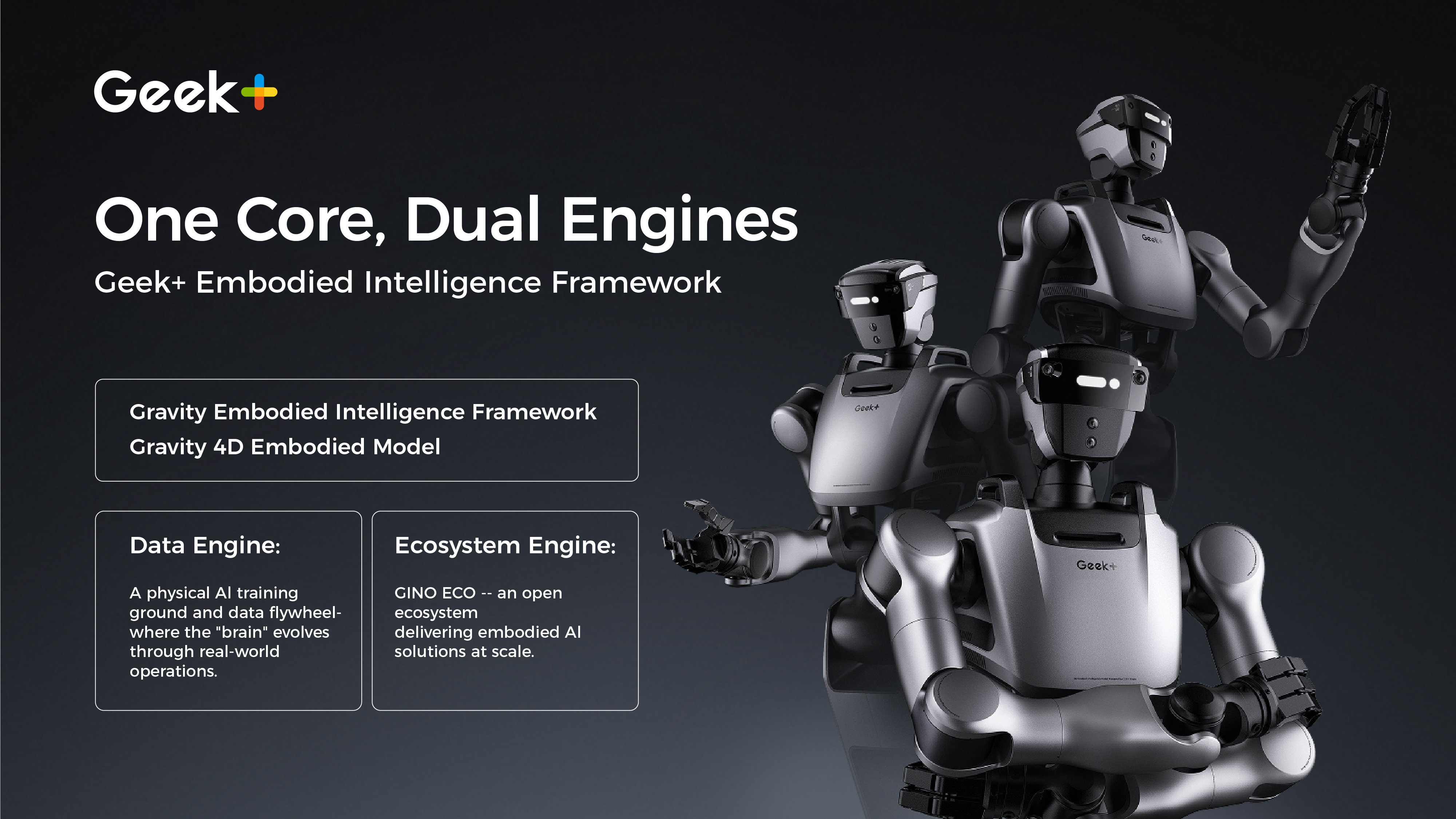
Alongside Gravity, Geek+ officially announced its "One Core, Dual Engine" strategy for advancing general-purpose embodied intelligence.
One Core, Dual Engine: A Complete Foundation for Embodied AI
One Intelligent Core (Gravity Framework)
Instilling robots with "physical intuition." Gravity enables robots to deeply understand the 3D world and "think before they act," serving as the ultimate technological foundation that grows smarter with real-world deployment.
The Data Engine
Leveraging Geek+'s industry-leading global logistics network to create the world's largest real-world Physical AI training ground and a data flywheel that allows embodied intelligence to evolve through real operations.
The Ecosystem Engine
Launching GINO ECO, an open ecosystem designed to accelerate large-scale commercial deployment of embodied AI. Positioned as an "Embodied AI Solution Expert," Geek+ is accelerating the transition from lab prototypes to industrial productivity.
Backed by over a decade of scenario-based expertise and proven commercial viability, this strategy creates a systemic, positive loop—from model evolution and data accumulation to large-scale deployment—propelling Geek+ on its new journey toward general-purpose robots and all-scenario applications.
Intelligent Core: Gravity "Dual-Brain" Framework — Think Clearly, Then Act
Previously, embodied AI technologies in the industry have long been fragmented: models that understand language and semantics cannot accurately compute physical motion, while models that can predict physical motion lack high-level semantic understanding and task planning — the "language brain" and the "physics brain" operate in silos.
Gravity breaks this bottleneck with a "Dual-Brain" architecture (Mixture-of-Transformers, MoT), endowing robots with a complete mindset of "think clearly before acting."
Cognitive Brain (AR Transformer) — The Staff Headquarters
Understands, deconstructs, and formulates plans. As the cognitive hub, it interprets complex human instructions, comprehends scene semantics, and precisely breaks down long-horizon tasks into executable sub-steps.
Action Brain (Diffusion Transformer) — The Frontline Commander
Simulates scenarios and generates actions. This is the core of Gravity 4D. Before acting, it "runs a mental simulation": if it reaches out that way, will the object slip? What are the consequences of different actions? After anticipating risks, it generates the safest sequence of continuous actions.
The Cognitive Brain sets the strategy; the Action Brain executes the tactics. Gravity makes embodied AI more "human-like": think it through, then act.
Beyond Visual Replication: Gravity 4D Gives Robots "Physical Intuition"
Conventional vision foundation models are trained primarily to predict future images. While visually convincing, they often violate fundamental physical principles—robot arms intersect objects, items float unnaturally, or interactions appear plausible on screen but fail completely in the real world.
Gravity 4D extends the 2D video prediction paradigm. Using the 4D latent representations extracted by Gravity 4D-VAE as teacher supervision, it simultaneously learns future RGB appearance, 3D structure, and 3D motion in latent space:
● Pointmaps represent "where objects are located."
● Scene flow represents "how objects move."
Without needing to supervise raw point clouds or explicit 3D pipelines, it distills prior knowledge from a 4D foundation model into WAM, shifting from "predicting visually plausible futures" to "modeling futures governed by 3D motion dynamics."
When the robotic arm reaches out, it has already understood geometric relationships, force dynamics, and contact changes in physical space—actions are not just "visually right," but "physically right."
Schematic of Gravity 4D Overall Architecture
Visualization: RGB, pointmap (Depth), and scene flow
On the public benchmark LIBERO-Plus, under zero-shot conditions, introducing 4D representations improved the primary version's success rate from 73.73% to 78.62%, with the optimal variant reaching 79.25%.
The most significant improvements occurred in three types of scenarios where "appearance changes but physics does not":
● Camera viewpoint shifts
● Sensor noise
● Lighting variations
These results directly validate the core hypothesis: the model learns physical laws, not visual patterns.
Ablation studies further show that the Pointmap-only variant performs exceptionally well (spatial structure is one of the most critical supervisory signals for manipulation), while simply adding depth prediction actually decreased performance (stacking modalities is ineffective; architectural pathways are key).
Deep Cognition, Fast Action — Embedding Physics into "Muscle Memory"
The "Dual-Brain" architecture gives robots both exceptional intelligence and ultimate execution efficiency.
During training, Gravity absorbs the laws of the 3D world like a sponge through multi-dimensional representations—vision, touch, force, etc.—this is deep cognition.
During real-world inference, the system automatically prunes redundant reasoning branches and outputs actions through a minimal-latency pathway—this is fast action.
This "add during training, subtract during execution" design allows robots to operate with extremely low latency and high success rates—much like professional athletes who, after thousands of hours of practice, develop "muscle memory": they don't need to consciously think; their bodies already know the right move.
Looking ahead, the Gravity framework will expand to incorporate richer physical representations—such as mass, friction, deformation, and contact force—alongside expert priors, hierarchical memory, and reinforcement learning-driven self-evolution. These capabilities will steadily drive the embodied brain toward a more complete grasp of the real physical world.
Data Engine: Powering the Flywheel with the World's Largest Training Ground
The core bottleneck for embodied AI is the extreme scarcity of real-world data, as simulations cannot authentically replicate friction, deformation, or unexpected anomalies. Whoever first builds a training ground that continuously generates high-quality data will have a brain that runs faster and grows smarter.
Geek+ has positioned warehouse picking as the world's largest, most diverse physical AI training ground to construct its embodied data flywheel.
Warehousing provides a "complex world with boundaries"—a relatively structured environment interwoven with endless dynamic changes, making it the optimal proving ground to balance model training difficulty with operational safety.
Furthermore, an industry consensus is forming: warehouse picking is the absolute "bullseye" for physical AI training. It uniquely meets the five rarest conditions required for model evolution.
High-Frequency
Warehouses worldwide generate hundreds of millions of real picking actions every day across millions of SKUs, creating an effectively limitless stream of high-quality training data.
Real-World
Robots interact directly with objects of different real-world materials, weights, shapes, and deformability—capturing physical nuances that simulation simply cannot reproduce.
Clear Feedback
Every task produces an unambiguous outcome—whether an item is successfully picked, whether timing requirements are met—providing exceptionally clean reward signals for reinforcement learning.
Transferability
Picking develops foundational capabilities including vision-language coordination, dexterous manipulation, force control, and spatial reasoning. These same capabilities transfer naturally to manufacturing, retail replenishment, pharmaceutical fulfillment, and virtually every task requiring physical interaction.
Commercial Closed-Loop
Embedded directly into live order flows and operating systems, the model's performance is calibrated in real-time by commercial results.
In essence, warehouse picking simultaneously tests perception, physical reasoning, planning, and fault tolerance. It is far more than a single application—it represents the foundational capability upon which general-purpose embodied intelligence can be built.
Within the robotics community, bin-picking has long been regarded as the field's "holy grail," not only because of its technical difficulty, but because solving it unlocks an entire hierarchy of robotic capabilities.
Five Strategic Advantages Driving the Flywheel into a Productivity Watershed
Sustaining this flywheel at scale requires capabilities that are exceptionally difficult to replicate. Geek+ has built five enduring competitive advantages.
1. The World's Largest Real-World Commercial Robotics Network
Operating across more than 1,700 projects in over 40 countries, Geek+ delivers AI-powered robotics solutions to over 950 global brands, including Walmart, Adidas, Siemens, and BMW. Its deployments span e-commerce, apparel, grocery, third-party logistics (3PL), automotive, and many other industries, collectively processing tens of millions of customer orders every day.
2. Application-Specific Model Optimization
Gravity 4D is purpose-built for high-frequency physical interaction scenarios such as warehouse picking, continuously optimized for real-world challenges including millions of SKUs, diverse materials, unconstrained object poses, and mixed human-robot environments.
3. Cross-Domain Generalization
Exposure to diverse operating environments across countries, cultures, warehouse configurations, and extreme operating conditions enables the models to develop exceptional adaptability and robustness in unfamiliar environments.
4. Large-Scale Multi-Robot Orchestration
With proven experience orchestrating fleets of more than 5,000 robots within a single warehouse, Geek+ enables embodied AI systems to develop collaboration as a native capability—allowing robots to function as coordinated workflows rather than isolated machines.
5. Dual-Track Safety Boundaries
Geek+ integrates cutting-edge embodied AI with its mature commercial robotics platform, creating a robust safety framework that encourages rapid innovation while ensuring uninterrupted customer operations. Models are free to evolve without compromising production reliability.
Together, these capabilities reinforce one another, allowing Geek+ to establish a powerful first-mover advantage through a continuous cycle of deployment, learning, and evolution, while creating a scalable foundation for expansion into manufacturing, retail, and many other physical industries.
Ecosystem Engine Strategy: GINO ECO — The Trusted Embodied AI Solution Expert
While the Data Engine fuels the evolution of embodied AI, commercial success ultimately depends on bridging the gap between breakthrough models and real-world deployment.
To accelerate this transition, Geek+ is launching GINO ECO, an open ecosystem designed to position the company as a trusted embodied AI solutions expert that connects technology supply with industry demand to accelerate the scaled monetization of embodied tech.
As an expert that deeply understands clients and can deliver closed-loop solutions, Geek+ will leverage its global business network, deep-rooted customer trust, scenario know-how, and delivery capabilities to share data with ecosystem partners, ultimately providing end-users with highly reliable, trustworthy solutions with calculable ROI.
Three Pillars of the GINO ECO Ecosystem
For AI Model Companies & Universities
Opening up a highly reliable, low-cost embodied robotic hardware platform to jointly develop applications tailored to warehousing and logistics pain points. Leveraging over a decade of hardware and supply chain expertise, Geek+ offers a highly cost-effective, ready-to-use "physical admission ticket" for the entire industry.
For Industry Leaders
Co-exploring innovative scenarios to bind cutting-edge AI deeply with real business workflows, expanding the boundaries of embodied AI's commercial application.
For Complementary Hardware Enterprises
Collaborating to build end-to-end embodied workflows, shattering the limitations of what a single company can achieve alone.
Why Go All-In on Openness? Three Strategic Convictions
Geek+'s decision to embrace an open ecosystem is built on three fundamental convictions about the future of embodied AI.
First, the technology landscape is still evolving, and a closed approach is self-restricting.
With diverse technological evolutions in embodied brains, no single company holds all the advantages. Only through sharing data and collaborative co-creation can the industry synthesize the best solutions that truly create value for clients.
Second, scenarios define hardware, and real-world data is the scarcest fuel.
Real operational data remains the industry's scarcest resource. Years of experience in warehouse logistics have given Geek+ deep scenario expertise and one of the world's richest collections of real-world operational data.
Through GINO ECO, the company is opening these commercial environments to ecosystem partners, enabling AI models to learn safely, iterate continuously, and mature under real production conditions while sharing the benefits of large-scale commercial deployment.
Third, embodied AI is a marathon, not a sprint.
Building an industry cannot be accomplished by one company alone. Geek+ aims to serve as the industry's super connector—bringing together AI model developers, research institutions, pioneering enterprise customers, and complementary robotics partners to accelerate innovation across the entire ecosystem.
Ultimately, GINO ECO transforms the embodied AI flywheel from a self-reinforcing engine into an ecosystem-wide engine—allowing more intelligent models to evolve in real-world environments and enabling a broader range of robotic platforms to become productive members of the global workforce.
"The ultimate value of embodied AI must be realized at the customer's site—this has been Geek+'s mission for the past 11 years and remains our guiding principle for the next decade," said Yong Zheng, Founder and CEO of Geek+. "Through the GINO ECO ecosystem plan, we hope to work alongside partners across the industry to transform ambitious technological breakthroughs into tangible business outcomes—delivering measurable productivity gains and sustainable commercial value across industries."
At the same time, Geek+ will continue to refine its proprietary embodied AI technologies, including the Gravity embodied AI foundation model and the GINO 1 humanoid robot to forge a battle-tested benchmark operational squad on commercial frontlines.
Beyond its own product portfolio, the company believes the industry's greatest opportunity lies in enabling an open ecosystem where diverse robotic platforms and application scenarios evolve together.
Demonstrating success with Geek+'s own robotic fleet is only the first step; the true transformation will come from an ecosystem in which intelligent robots of many forms collaborate across industries, unlocking the next generation of productivity in the era of Physical AI.